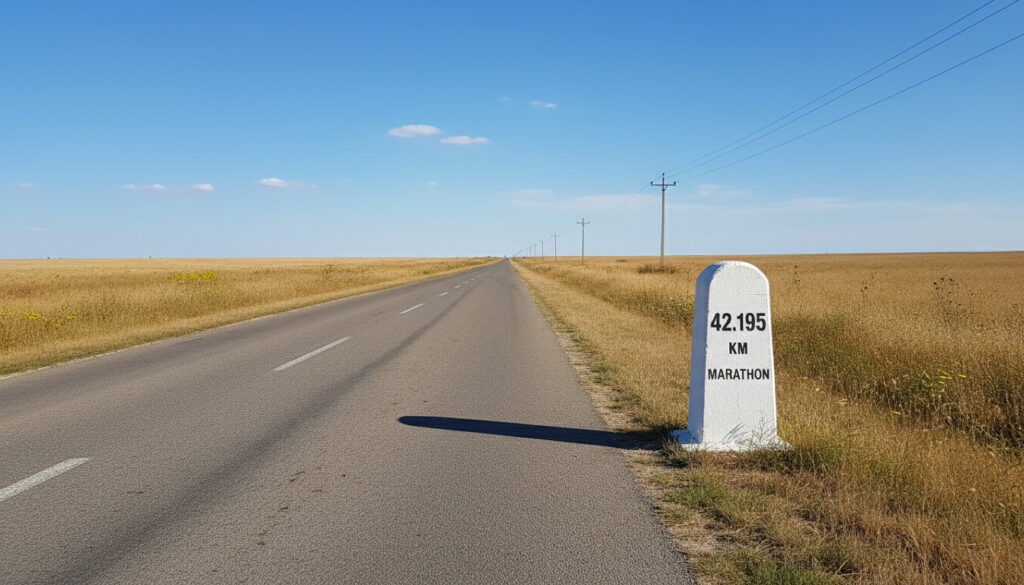
How Many Km Is A Marathon – Exact 42.195 km Distance Explained
The standard marathon distance measures exactly 42.195 kilometers, a figure established by international athletics governing bodies over a century ago. This precise length, equivalent to 26 miles and 385 yards, represents the globally recognized standard for all official marathon events, from local road races to the Olympic Games.
While many runners casually reference “42 kilometers” or “26.2 miles,” the specific measurement of 42.195 km carries significant historical weight rooted in early Olympic history. Understanding this exact distance proves essential for proper race preparation and course certification.
From ancient Greek battlefields to modern measurement technologies, the marathon length has undergone substantial refinement to reach its current standardized form.
How Many KM is a Marathon?
- The official distance is 42.195 km, not exactly 42 km
- World Athletics mandates this exact measurement for all certified courses
- Courses may exceed this by up to 42 meters to prevent short-course errors
- The “short course prevention factor” adds approximately 1 meter per kilometer
- Measurement requires tools like the Jones counter with 0.1% accuracy
- All world records require precise course certification
- Standardization occurred in 1921, first applied to 1924 Olympics
| Metric | Value | Notes |
|---|---|---|
| Full Marathon | 42.195 km | Official standard since 1921 |
| Half Marathon | 21.0975 km | Exactly half |
| Miles Equivalent | 26.2188 mi | US common unit |
| Yards Equivalent | 46,145 yards | Total yards in 42.195 km |
| Meters | 42,195 m | Standard SI unit |
| Tolerance | +42 m | Maximum excess allowed |
| Standardization Year | 1921 | IAAF decision |
| First Standardized Olympics | 1924 | Paris Games |
| Previous 1908 Distance | 42.195 km | London Olympics |
| 1896 Athens Distance | ~40 km | Approximate |
| Measurement Tool | Jones Counter | 0.1% accuracy required |
| Governing Body | World Athletics | Formerly IAAF |
How Many Miles is a Marathon?
The conversion yields 26 miles and 385 yards, commonly rounded to 26.2 miles. Neither imperial nor metric systems were prioritized in the original measurement; the odd figure reflects the 1908 course layout in London. For runners tracking miles, this translates to approximately 26.219 miles.
KM to Miles Conversion
The 385 yards added in 1908 represent roughly 352 meters of additional distance inserted to accommodate the royal viewing box at White City Stadium. This specific adjustment created the non-round number that persists today. For comparison, 44 inches in cm demonstrates how precise measurements translate between systems, much like the marathon’s exacting standards.
Modern GPS watches and running apps typically display 26.2 miles as the target, though elite record attempts require the full 26.2188-mile precision. The distance does not divide evenly into laps on a standard 400-meter track, requiring specific course design for looped marathon events.
Why is a Marathon 42.195 KM?
The distance derives from the 1908 London Olympics where organizers positioned the start at Windsor Castle beneath the royal nursery windows. The finish line sat at White City Stadium, initially calculating about 26 miles. However, a last-minute route change rerouted runners to enter the stadium opposite and complete 385 yards around the track, ending precisely before King Edward VII’s royal box.
Historical Standardization
This adjustment created the exact 42.195 km measurement. In May 1921, the International Amateur Athletic Federation adopted this as the global standard, implemented from the 1924 Paris Olympics onward. The specific route choices made in 1908 continue to define the sport today.
World Athletics allows courses to exceed 42.195 km by up to 42 meters using a “short course prevention factor” of approximately 1 meter per kilometer to ensure records aren’t set on accidentally shortened routes.
The additional 385 yards were added specifically to allow Queen Alexandra and royal children to view the finish from their nursery windows at Windsor Castle, then watch the final lap from the royal box. Historical documentation confirms this logistical requirement drove the final measurement.
How Many KM is a Half Marathon?
The half marathon measures exactly 21.0975 kilometers, precisely half of the full marathon distance. This translates to 13 miles and 192.5 yards, or approximately 13.109 miles. Like the full marathon, this distance follows the 1921 IAAF standardization.
Common Race Variations
The consistency allows runners to easily compare performances across different events and plan training cycles using the mathematical relationship between the two distances. Whether checking What is the date today for race scheduling or calculating split times, the 2:1 ratio remains constant across all official events.
Both full and half marathons maintain exact mathematical relationships: 42.195 km divided by 2 equals 21.0975 km, ensuring standardized race planning globally. Official rules govern both distances equally.
How Has the Marathon Distance Evolved?
- 490 B.C. — Pheidippides reportedly runs approximately 40 kilometers from Marathon to Athens to announce victory over Persian forces, collapsing from exhaustion afterward. Historical accounts document this legendary feat.
- 1896 — The first modern Olympic Games in Athens features a roughly 40 km race, though the exact distance varies between 40 and 40.26 km depending on the course layout.
- 1908 — London Olympics establishes the 42.195 km distance due to royal viewing requirements and stadium logistics.
- 1921 — The IAAF officially standardizes 42.195 km as the global marathon distance in May of this year.
- 1924 — The Paris Olympics becomes the first Games to use the officially standardized 42.195 km distance.
- Present — World Athletics continues to enforce this exact measurement with modern certification tools.
Is a Marathon Exactly 42 KM?
| Established Information | Information That Remains Unclear |
|---|---|
| All official marathons are exactly 42.195 km (42,195 meters) per World Athletics rules. | Whether Pheidippides actually ran from Marathon to Athens or to Sparta first remains historically debated. |
| The IAAF standardized this distance in 1921 based on the 1908 London route. | The exact route of the original 490 B.C. run cannot be verified. |
| Courses must be measured with precision tools like the Jones counter. | Some informal or trail marathons may advertise as “marathons” without certification. |
| All world records require this exact distance with proper certification. | Historical accounts of Pheidippides’s death immediately after the run vary in detail. |
What is the Origin of the Marathon Distance?
The name originates from the Battle of Marathon in 490 B.C., where Greek messenger Pheidippides allegedly ran from the battlefield to Athens to deliver news of victory over the Persians. While historical accounts suggest this original run measured approximately 40 kilometers, modern sporting events did not immediately adopt a standardized length. The marathon’s origin is tied to a legendary run from Marathon to Athens, a distance that has since been standardized, much like the precise measurements needed for air fryer pork chops.
Early Olympic Games featured distances ranging from 40 to 42.75 kilometers until the 1908 London Games provided the specific measurement that would eventually become universal. The 1908 course layout prioritized accommodating British royalty over mathematical precision, resulting in the odd figure that persists today. Video documentation illustrates how the Windsor Castle start and White City Stadium finish determined the final length.
The standardization process completed in 1921 ensured that this arbitrary but historically significant distance would become the global benchmark for endurance running.
What Do Official Athletics Bodies Say?
The distance shall be 42,195 metres.
— World Athletics Official Rules
The 1908 London Olympics course was measured to finish precisely in front of the Royal Box, adding 385 yards to the initial 26-mile course.
— IOC Historical Records
What Should Runners Remember About Marathon Distance?
A standard marathon measures exactly 42.195 kilometers or 26.2188 miles, standardized by World Athletics since 1921 based on the 1908 London Olympics route. While half marathons measure precisely half at 21.0975 km, all official full marathons maintain this exact distance regardless of location or course design.
Frequently Asked Questions
Are all marathons the same distance?
Yes, official marathons are standardized at exactly 42.195 km worldwide by World Athletics rules.
Why isn’t a marathon exactly 42 km?
The extra 195 meters derive from the 1908 London Olympics course measurement ending at the royal box, creating 42.195 km.
How many miles is a marathon exactly?
Exactly 26 miles and 385 yards, or approximately 26.219 miles.
What is a half marathon in km?
Exactly 21.0975 km, precisely half of 42.195 km.
Who decides the official marathon distance?
World Athletics (formerly IAAF) governs and certifies all official marathon distances globally.
Can marathon courses be shorter than 42.195 km?
No, courses must be at least this length, though they may exceed it by up to 42 meters to prevent measurement errors.
When did marathons become 42.195 km?
The IAAF standardized this distance in 1921, first used in the 1924 Paris Olympics.
More related posts
 iPhone 12 Release Date – Exact Timeline for All Models
 How To Check My Credit Score – Free UK Solutions Compared
 David Warner (Actor) – Biography, Iconic Roles and Legacy
 Cardi B – Net Worth 2025, Divorce, Kids, and Career Updates
 Do Not Disturb iPhone – Turn On, Schedule, and Troubleshoot
 Cast of Wedding Crashers – Full Cast List and Cameo Guide
 Louis Vuitton Ombre Nomade – In-Depth Review and Pricing Guide
 How Old Is Shania Twain – Age, Family and Career Facts
