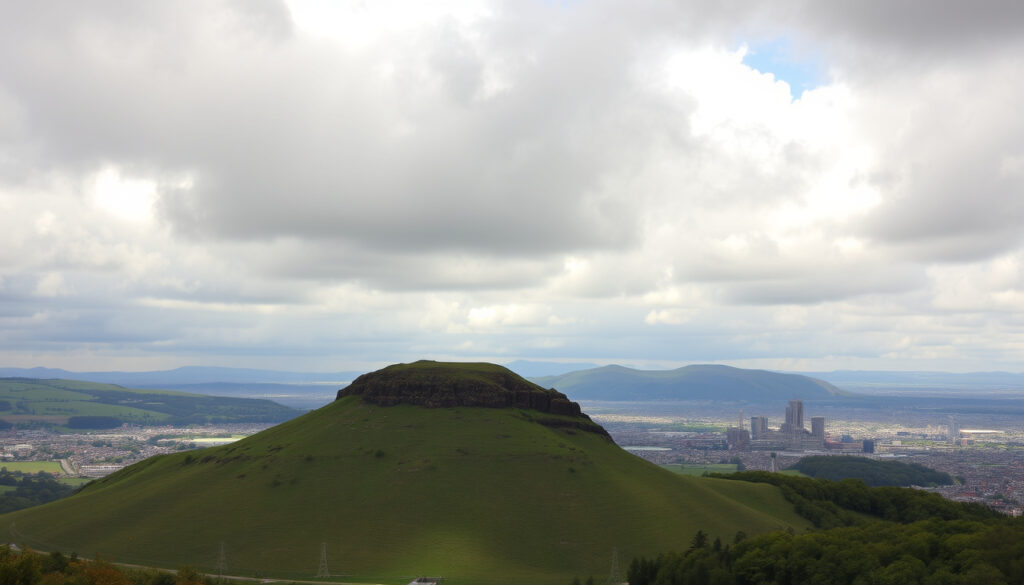
Arthur’s Seat – Essential Guide to Edinburgh’s Ancient Volcano
In the heart of Edinburgh, rising from the green expanse of Holyrood Park, Arthur’s Seat draws thousands of visitors each year. The hill is an ancient extinct volcano, a landmark visible from much of the city, and a destination for walkers seeking panoramic views. Its summit reaches 251 metres above sea level, making it the highest point in the park.
Arthur’s Seat is not just a natural feature – it is a place shaped by deep time, human history, and legend. The rocks beneath your feet date back to the Carboniferous period, and the name itself carries centuries of speculation. This article brings together the geology, the walking routes, the history, and the unanswered questions surrounding one of Scotland’s most iconic hills.
Whether you are planning your first climb or simply curious about its origins, the following sections provide a fact-based, practical guide to Arthur’s Seat, grounded in official sources and expert accounts.
Why Is It Called Arthur’s Seat? The Origin of the Name
The origin of the name is debated, and no single explanation has been universally accepted. The most common theory links the hill to King Arthur, but evidence remains circumstantial.
- Arthur’s Seat is the remnant of a Carboniferous volcano that last erupted over 300 million years ago – it is now extinct.
- The name ‘Arthur’s Seat’ has been linked to King Arthur since at least the 16th century, but the exact origin remains uncertain.
- The hill offers a moderate walk suitable for most fitness levels, with multiple routes and panoramic views of Edinburgh from the summit.
- Recent fire incidents in 2024 prompted temporary closures; always check official updates before visiting.
- Arthur’s Seat is part of a larger group of hills within Holyrood Park, which also contains three other hill forts.
| Attribute | Value |
|---|---|
| Height | 251 m (823 ft) |
| Prominence | 186 m (610 ft) |
| Location | Holyrood Park, Edinburgh |
| Age | ~350 million years (Carboniferous) |
| Volcanic status | Extinct – last eruption over 300 million years ago |
| First recorded name | 16th century (associated with King Arthur) |
| Number of walking routes | 3 main routes (Salisbury Crags path, Dunsapie Loch path, Radical Road) |
The History and Geology of Arthur’s Seat: Volcano, Ice Age, and Hill Fort
An Extinct Volcano in the City
Arthur’s Seat is what remains of a volcano that was active during the early Carboniferous period, around 342 million years ago. Lava flows spread across the area, and volcanic vents left behind agglomerate and other rocks. Over millions of years, erosion and glaciation removed the original cone, leaving the current hill and its distinctive crags. The British Geological Survey explains that the park still preserves volcanic rock formations, vents, and lava flows that shaped the landscape.
Later geological processes added tropical swamps, shallow seas, and glacial ice streams, all of which left their mark on the rock record. Lava samples from the wider volcanic system have been dated to between 341 and 335 million years ago. Multiple sources confirm that Arthur’s Seat is an extinct volcano – not dormant and not active. Wikipedia’s entry notes the hill’s volcanic origin and its status as a remnant.
Human Activity Through the Ages
People have been present at Arthur’s Seat for thousands of years. According to Historic Environment Scotland, stone and flint tools found in Holyrood Park reveal human activity as far back as 5000 BC. Later, during the Iron Age, the hill was part of a fortified landscape. Arthur’s Seat is one of four hill forts within the park, suggesting its strategic importance in ancient times.
The 1590 Bonfire
A notable historical fire occurred on 1 May 1590. A bonfire fuelled with coal and tar was lit on Salisbury Crags to celebrate the safe return of James VI of Scotland and Anna of Denmark. This is the clearest recorded fire event directly tied to the area, though it was a celebratory blaze rather than a wildfire.
Do not confuse Edinburgh’s Arthur’s Seat with the well-known Arthur’s Seat in Victoria, Australia, which was named after the Edinburgh landmark.
How to Walk Up Arthur’s Seat: Routes, Maps, and Tips
Main Walking Routes
Arthur’s Seat is accessible via several trails, ranging from gentle slopes to steeper ascents. The three main routes are the Salisbury Crags path, the Dunsapie Loch path, and the Radical Road. Walkhighlands describes the walk as moderate and suitable for most walkers with reasonable fitness. The shortest ascent takes about 30–45 minutes, while a full circuit of Holyrood Park can take 2–3 hours.
One source notes that there are five different hiking trails to the top, with two main starting areas: near Dunsapie Loch Car Park and along Queen’s Drive by the Palace of Holyroodhouse. The loop trail around the hill is approximately 4.3 km and typically takes around 1 hour 41 minutes, according to AllTrails.
Maps and Route Planning
Several resources provide maps and route guidance. Geowalks offers a dedicated walking route map with variations for different abilities. The British Geological Survey also provides a geological walk that links the summit with key outcrops such as Salisbury Crags, St Anthony’s Chapel, and Samson’s Ribs. For those planning a visit, our Holyrood Park guide offers additional insights on the surrounding area.
Practical Tips for First-Time Visitors
Holyrood Park is free to enter and open year-round. Public toilets are available at the visitor centre (limited hours). Parking exists at the Broad Pavement, Dunsapie Loch, and the Holyrood Palace car park (paid). Bus routes 30 and 33 serve the area. Dogs are allowed but must be kept under control, especially near cliffs and livestock.
Always check for trail closures before setting out. Recent wildfires in 2024 led to temporary closures, and weather conditions can make paths slippery and uneven. Stick to marked trails and carry water.
The Arthur’s Seat Fire: What Happened and When?
In 2024, a wildfire was reported on Arthur’s Seat, prompting sections of the hill to be temporarily closed for safety. The exact cause of the fire and its full impact are not yet fully detailed in official sources. For the latest updates, consult the Historic Environment Scotland website. The organisation manages Holyrood Park and provides official information on access and conservation.
This recent fire is separate from the historical bonfire of 1590. The 2024 event has raised awareness about fire risks in the park, especially during dry periods. Visitors are advised to follow all posted signs and avoid any activities that could spark a fire.
A Timeline of Arthur’s Seat: From Volcano to Present Day
- ~350 million years ago (Carboniferous): Volcanic formation; eruption of lava and ash builds the hill.
- ~10,000 years ago (post-glacial): Ice Age glaciers sculpt the landscape, leaving Arthur’s Seat as a prominent crag.
- ~5000 BC – 2000 BC (Prehistoric): Human activity: stone and flint tools found; later hill forts built around 2000 years ago.
- 16th century: Earliest known reference to ‘Arthur’s Seat’ in written records, associating it with King Arthur.
- 19th–20th centuries: Holyrood Park becomes a public park; walking paths maintained; tourism grows.
- 2024: Wildfire reported on Arthur’s Seat; sections temporarily closed for safety.
What Do We Know for Sure About Arthur’s Seat?
| Established Information | Information That Remains Unclear |
|---|---|
| Arthur’s Seat is an extinct volcano, last active over 300 million years ago. | The exact origin of the name ‘Arthur’s Seat’ is not definitive. While most sources link it to King Arthur, there is no contemporary evidence connecting him directly. Alternative theories (e.g., from Scottish Gaelic ‘Ard-na-Said’ – ‘height of the arrows’) are speculative. |
| It is located within Holyrood Park, Edinburgh. | The cause and full impact of the 2024 fire may not be fully detailed in available sources; official reports should be consulted. |
| The hill has been used by humans since at least 5000 BC. | Whether Arthur’s Seat was specifically used as a hill fort or merely part of a broader Iron Age landscape is debated among archaeologists. |
| It has a height of 251 m and offers multiple walking routes. |
Arthur’s Seat in a Wider Context: Hill Forts, Geology, and Conservation
Arthur’s Seat is the most prominent of four hill forts in Holyrood Park, indicating its strategic importance in Iron Age Scotland. It is part of the same volcanic complex that formed Salisbury Crags, and the rocks exposed here offer a window into Scotland’s geological past. The hill continues to serve as a natural landmark and recreational hub for Edinburgh residents and tourists, with over one million visitors annually. Ongoing conservation work by Historic Environment Scotland balances public access with the preservation of archaeological and geological features.
What the Experts Say About Arthur’s Seat
“Arthur’s Seat is an ancient volcano located in the heart of Edinburgh at the foot of the Royal Mile.”
Cockburn Association, ‘Why is it called Arthur’s Seat?’ (2024)
“It is the main peak of a group of hills in Edinburgh, Scotland, which form most of Holyrood Park.”
Wikipedia – Arthur’s Seat
“Arthur’s Seat, the park’s highest point, is the remains of a volcano, and stone and flint tools found here reveal human activity as far back as 5000 BC.”
Historic Environment Scotland – Visit Holyrood Park
What Makes Arthur’s Seat Worth Visiting?
Arthur’s Seat offers a rare combination of natural beauty, deep geological history, and easy access from Edinburgh’s city centre. Whether you come for the views, the volcanic rocks, or the sense of walking in a landscape shaped over hundreds of millions of years, it remains one of Scotland’s most rewarding urban walks. For more inspiration, see our best viewpoints in Edinburgh.
Frequently Asked Questions
Is there an entrance fee for Arthur’s Seat?
No, Holyrood Park is free to access. Arthur’s Seat is open to the public year-round.
Can I bring my dog to Arthur’s Seat?
Yes, dogs are allowed in Holyrood Park but must be kept under control, especially near livestock and cliffs.
How long does it take to walk up Arthur’s Seat?
Most walkers complete the ascent in 30–45 minutes via the shortest route; the full circuit of the park can take 2–3 hours.
Is Arthur’s Seat suitable for beginners?
Yes, the main paths are moderate and suitable for walkers with reasonable fitness. Some sections are steep and uneven.
Where can I park near Arthur’s Seat?
Parking is available at Holyrood Park at the Broad Pavement, Dunsapie Loch, and the Holyrood Palace car park (paid).
Are there toilets or facilities at Arthur’s Seat?
Public toilets are available at the Holyrood Park Visitor Centre (limited hours). There are no facilities on the hill itself.
More related posts
 Man City vs Aston Villa – Tickets, History and Match Guide
 Rent a Car London – Cheapest Rates at Heathrow and Tips
 Luton Town F.C. – Complete Club Profile and Latest Updates
 How to Make Corned Beef Ha h with Canned Corned Beef – 3 Way
 44 Inches in CM – Exact Conversion Formula
 How Old Is Prince William – Age, Birthday and Family Facts
 Akita Dog – Complete Guide to Temperament and Care
 Evri Customer Service Number – Phone, Live Chat and Hours
