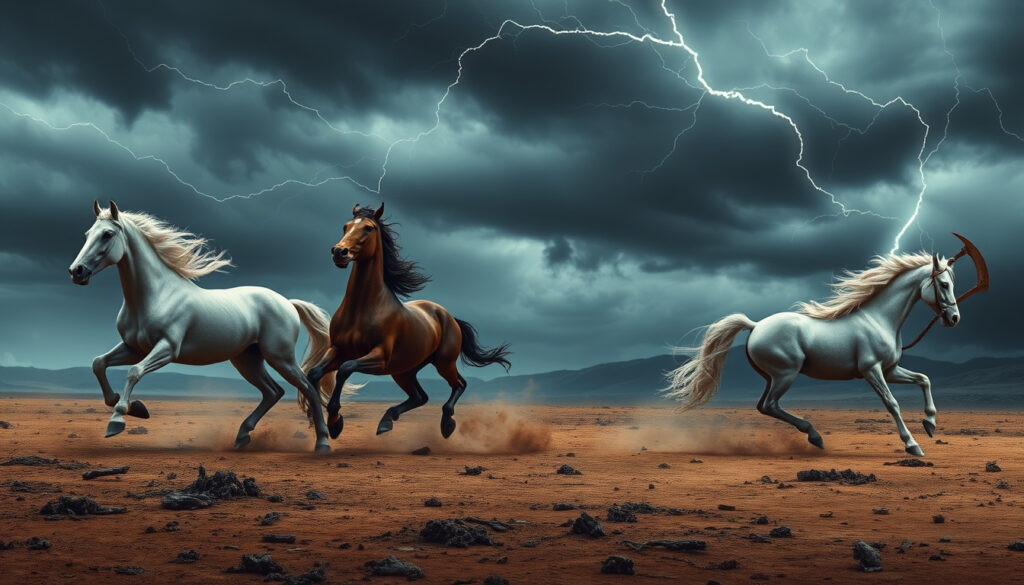
Four Horsemen of the Apocalypse – Names, Meanings and Bible Order
What Are the Names and Meanings of the Four Horsemen of the Apocalypse?
The Four Horsemen of the Apocalypse appear in the New Testament Book of Revelation, chapter 6, when the Lamb opens the first four of seven seals. Each seal releases a rider on a horse of a distinct colour, and the figures are widely understood to represent divine judgments unleashed upon the earth. The traditional names are Conquest (or Pestilence), War, Famine, and Death, though the exact identity of the first rider remains a point of debate among scholars.
The Four Horsemen at a Glance
| Horseman | Colour | Symbolises | Symbol | Key Verse |
|---|---|---|---|---|
| First Horseman | White | Conquest (or Pestilence) | Bow and crown | Revelation 6:2 |
| Second Horseman | Red | War / Conflict | Great sword | Revelation 6:4 |
| Third Horseman | Black | Famine | Scales (measuring food) | Revelation 6:5-6 |
| Fourth Horseman | Pale (greenish-gray) | Death | Hades following | Revelation 6:8 |
Key Insights
- The Four Horsemen appear in Revelation 6 when the Lamb opens the first four of seven seals.
- The identity of the first horseman is the most debated: Conquest (Christ spreading the Gospel) or Pestilence/Plague (a force of destruction).
- The phrase “Four Horsemen of the Apocalypse” does not appear verbatim in the Bible; it is a later colloquial title.
- The colours of the horses (white, red, black, pale) carry deep symbolic meaning tied to victory, bloodshed, mourning, and death.
- The Horsemen are understood by most scholars as symbolic rather than literal individuals, representing divine judgment on humanity.
Key Facts: Four Horsemen of the Apocalypse
| Fact | Detail |
|---|---|
| Source | Book of Revelation, New Testament |
| Author tradition | John of Patmos (traditionally John the Apostle) |
| Chapter | Revelation 6:1-8 |
| Number of Horsemen | 4 |
| Primary interpretation | Forces of divine judgment let loose upon the earth |
| Common modern reinterpretation | War, Famine, Plague/Pestilence, Death |
| Earliest known artwork | Albrecht Dürer’s woodcut (1498) |
| Cultural influence | Endless references in film, literature, music, anime, and manga |
Where in the Bible Are the Four Horsemen Described and in What Order Do They Appear?
The passage is found in Revelation 6:1-8. The Lamb, representing Christ, opens the first four seals of a scroll in heaven, and each seal releases a horseman. The order is fixed: first the white horse, then the red, then the black, and finally the pale horse. These four are followed by three more seals that continue the sequence of apocalyptic judgments, as noted by sources such as David Jeremiah.
The horsemen are the first four of seven seals. The remaining three seals – the fifth (martyrs), sixth (cosmic upheaval), and seventh (silence in heaven) – do not involve horsemen but continue the judgment narrative.
The Order of the Four Horsemen in Revelation 6 (The Seven Seals)
- First Seal – A white horse appears with a rider holding a bow, given a crown, riding out to conquer. (Revelation 6:1-2) – Conquest (or Pestilence)
- Second Seal – A fiery red horse appears. Its rider is given a great sword and power to take peace from the earth, causing people to kill each other. (Revelation 6:3-4) – War
- Third Seal – A black horse appears. Its rider holds a pair of scales. A voice declares food prices (a measure of wheat for a denarius). (Revelation 6:5-6) – Famine
- Fourth Seal – A pale horse (greenish-gray) appears. The rider is named Death, and Hades follows closely. They are given power to kill by sword, famine, plague, and wild beasts. (Revelation 6:7-8) – Death
The full passage can be read at Bible Gateway.
What Does Each Horse Color (White, Red, Black, Pale) Symbolize?
The colours of the horses are not explicitly defined in the Bible itself, so interpreters infer their meaning from broader biblical and cultural contexts. According to Britannica, white can suggest victory or imitation of righteousness, red bloodshed, black scarcity, and pale disease, death, or corpse-like lifelessness.
White Horse – Conquest or Pestilence
The white horse is the most debated. The rider has a bow and is given a crown. In many Protestant interpretations, this rider is the Antichrist, a false conqueror who mimics Christ. Others see Christ himself spreading the Gospel. The ambiguity arises because white can symbolise purity and victory, and Christ later rides a white horse in Revelation 19.
The Greek word for “conquer” (nikao) used in Revelation 6:2 can imply either righteous conquest or aggressive domination, which fuels the debate over the first horseman’s identity.
Red Horse – War
The second rider is given power to take peace from the earth and cause people to slay one another. The red colour is universally associated with bloodshed and war. According to The Gospel Coalition, the great sword symbolises large-scale conflict.
Black Horse – Famine
The third rider carries balances or scales, and a voice announces inflated grain prices – a denarius for a measure of wheat, indicating severe economic hardship and scarcity. The black colour represents mourning and famine. Ligonier Ministries notes that the imagery points to food shortage as a judgment.
Pale Horse – Death
The fourth rider is explicitly named Death, with Hades following. The horse’s colour, from the Greek “chloros” (pale greenish-yellow), evokes a corpse-like appearance. This rider is given authority over a quarter of the earth to kill by sword, famine, plague, and wild beasts. David Jeremiah explains that this cascade of destruction mirrors Jesus’ prophecy in Matthew 24.
Is the First Horseman (White Horse) Christ or the Antichrist?
This is one of the most enduring interpretive questions in Revelation studies. Scholars are divided. On one hand, white is the colour of righteousness in many biblical passages, and Christ is described as riding a white horse in Revelation 19:11-16. Some early Church Fathers, such as Irenaeus, saw the white horse as Christ spreading the Gospel. On the other hand, many modern Protestant interpreters, including GotQuestions.org, argue that the rider is the Antichrist, a counterfeit conqueror who appears before the true Christ.
Key Arguments
- Christ interpretation: The white horse symbolises victory and purity; the bow may represent the spread of the Gospel; the context of the Lamb opening the seal suggests a righteous agent.
- Antichrist interpretation: The rider goes out “conquering and to conquer,” which fits a false messiah; the bow without arrows could imply deceptive peace; later horsemen bring war, famine, and death – a logical sequence that begins with a false peace.
- Pestilence interpretation: In modern popular culture, the first horseman is often called Pestilence or Plague, though this substitution is not directly from the biblical text. The Bible itself lists “plague” as one of the means of the fourth horseman (Revelation 6:8).
The Bible does not explicitly name the first rider. The terms “Antichrist” and “Pestilence” come from later interpretive traditions, not from Revelation 6:1-8 itself.
What Is the Origin and Historical Context of the Four Horsemen of the Apocalypse?
The Book of Revelation was written by John of Patmos (traditionally identified as the Apostle John) near the end of the first century AD. It belongs to the apocalyptic literary genre, which uses vivid symbolism to convey messages of hope and judgment. The imagery of coloured horses and riders draws from Old Testament visions, such as Zechariah’s horses (Zechariah 1:8-10; 6:1-8).
Ligonier Ministries emphasises that the horsemen are expressions of God’s judgment, not Satanic agents, because they are unleashed by the Lamb. The sequence of conquest, war, famine, and death forms a logical cascade of human suffering, often linked to the “birth pains” described in the Olivet Discourse (Matthew 24, Luke 21). Early Church Fathers and later theologians have offered varying interpretations, especially regarding the white horse. The phrase “Four Horsemen of the Apocalypse” became widely used in modern culture through art, sermons, and media, not through direct scripture.
How Have the Four Horsemen Been Portrayed in Art, Literature, and Popular Culture?
The four horsemen have become a powerful symbol of apocalypse and catastrophe beyond religion. One of the most famous artistic depictions is Albrecht Dürer’s woodcut from 1498, which fixed the image of the four riders in the Western imagination. The Fitzwilliam Museum holds a high-quality print of this work and provides scholarly context.
In subsequent centuries, the horsemen have appeared in literature, film, music, and political rhetoric. They are used as shorthand for catastrophic forces or civilisation-scale collapse. In modern media, the concept has been adapted in the manga and anime series “Four Knights of the Apocalypse,” a sequel to “The Seven Deadly Sins.” The theme of apocalyptic horsemen also resonates with broader eschatological narratives, such as those explored in the article on Army of the Dead, which deals with themes of death and destruction.
For a comprehensive overview of the horsemen’s history and interpretations, the Wikipedia article provides extensive citations and cultural references.
The Order of the Four Horsemen in Revelation 6 (The Seven Seals)
The first four seals release the four horsemen in a fixed sequence. The remaining three seals (fifth, sixth, and seventh) continue the vision without introducing new riders. Below is the chronological order of the seals as they appear in Revelation 6.
- First Seal: White horse – Conquest (or Pestilence) – Revelation 6:1-2
- Second Seal: Red horse – War – Revelation 6:3-4
- Third Seal: Black horse – Famine – Revelation 6:5-6
- Fourth Seal: Pale horse – Death – Revelation 6:7-8
- Fifth Seal: Souls of martyrs under the altar – Revelation 6:9-11
- Sixth Seal: Cosmic disturbances (earthquake, sun darkened) – Revelation 6:12-17
- Seventh Seal: Silence in heaven for half an hour – Revelation 8:1
Commentary from Matthew Henry’s Commentary and the Catholic Encyclopedia provides further theological insight into the seal sequence.
What We Know vs. What Is Debated about the Four Horsemen
| Established Information | Information That Remains Unclear |
|---|---|
| The four horsemen appear in Revelation 6:1-8 as part of the seven seals. | The identity of the first rider is debated: Christ (Conquest of the Gospel) vs. the Antichrist vs. Pestilence. |
| The horses are coloured white, red, black, and pale (Greek: chloros). | The original Greek word for the first rider’s mission (nikao – conquer) is ambiguous in intent. |
| The fourth rider is explicitly named Death, with Hades following. | Whether the horsemen are literal beings or purely symbolic representations of judgment. |
| The passage is part of Christian eschatological literature. | The modern substitution of “Pestilence/Plague” for “Conquest” is not directly from the Bible but a later interpretive tradition. |
Interpretation and Context of the Four Horsemen in Biblical Eschatology
The four horsemen are widely seen as divine agents of judgment, not satanic figures, as they are unleashed by the Lamb (Christ). The sequence of conquest, war, famine, and death forms a logical cascade of human suffering, often linked to the “birth pains” described in the Olivet Discourse (Matthew 24). Early Church Fathers like Irenaeus and later theologians have offered varying interpretations, especially regarding the white horse. The phrase “Four Horsemen of the Apocalypse” became popularised in modern culture through art, sermons, and media.
Scholars such as Dr. Craig R. Koester (Luther Seminary) emphasise the symbolic and apocalyptic literary genre, cautioning against literalistic readings. The Britannica entry notes that the horsemen are commonly understood as symbols of conquest, war, famine, and death.
Primary Source and Expert Commentary on the Four Horsemen
The primary source is the Holy Bible, Revelation 6:1-8. Below is the opening of the passage in the New International Version:
I watched as the Lamb opened the first of the seven seals. Then I heard one of the four living creatures say in a voice like thunder, “Come!” I looked, and there before me was a white horse! Its rider held a bow, and he was given a crown, and he rode out as a conqueror bent on conquest.
— Revelation 6:1-2 (NIV)
Expert commentary from Matthew Henry’s Complete Commentary interprets the white horse as representing the victorious spread of the Gospel, while other scholars disagree. The Catholic Encyclopedia provides a historical overview of apocalyptic literature.
What Is the Enduring Significance of the Four Horsemen?
The Four Horsemen of the Apocalypse remain one of the most recognisable symbols of divine judgment and human catastrophe. Their imagery continues to resonate in religious, artistic, and popular contexts, serving as a powerful metaphor for the forces that can unravel civilisation. For further exploration of symbolic systems, see the article on Signs of the Zodiac.
Frequently Asked Questions
Are the Four Horsemen of the Apocalypse in the Old Testament?
No. They appear exclusively in the New Testament, in the Book of Revelation (Chapter 6).
What is the “Four Horsemen of the Apocalypse” book?
This likely refers to various interpretations and novels. Most commonly, it refers to the biblical passage or a study/sermon book on Revelation.
Is there a “Four Horsemen of the Apocalypse” anime?
Yes, there is a manga and anime adaptation titled “Four Knights of the Apocalypse” (or “Mokushiroku no Yonkishi”), a sequel to “The Seven Deadly Sins”.
What does “conquest” mean in the context of the first horseman?
It often means the rider “went out conquering and to conquer.” It can symbolise the spread of the Gospel (Christ’s conquest) or military/imperial conquest.
Why are the Four Horsemen sometimes called “War, Famine, Plague, and Death”?
This is a popular modern reinterpretation. “War” and “Famine” are directly from the text. “Plague” is substituted for the first rider (Conquest), and “Death” is the fourth rider. The text itself lists “sword, famine, plague, and wild beasts” as means of Death.
More related posts
 Arthur’s Seat – Essential Guide to Edinburgh’s Ancient Volcano
 Pete Wicks and Jowita – Dating Rumors and Strictly Status
 What Is a Chemical Pregnancy – Causes, Symptoms, Next Steps
 Area of a Triangle – Formulas and Step-by-Step Guide
 New Look Discount Code – Verified Working Codes for 2026
 Peru State of Emergency Travel Warning – What You Need to Know
 Signs of the Zodiac – Complete Guide to Dates, Traits and Compatibility
 Can You Freeze Cooked Rice – Safe Storage and Reheating Tips
