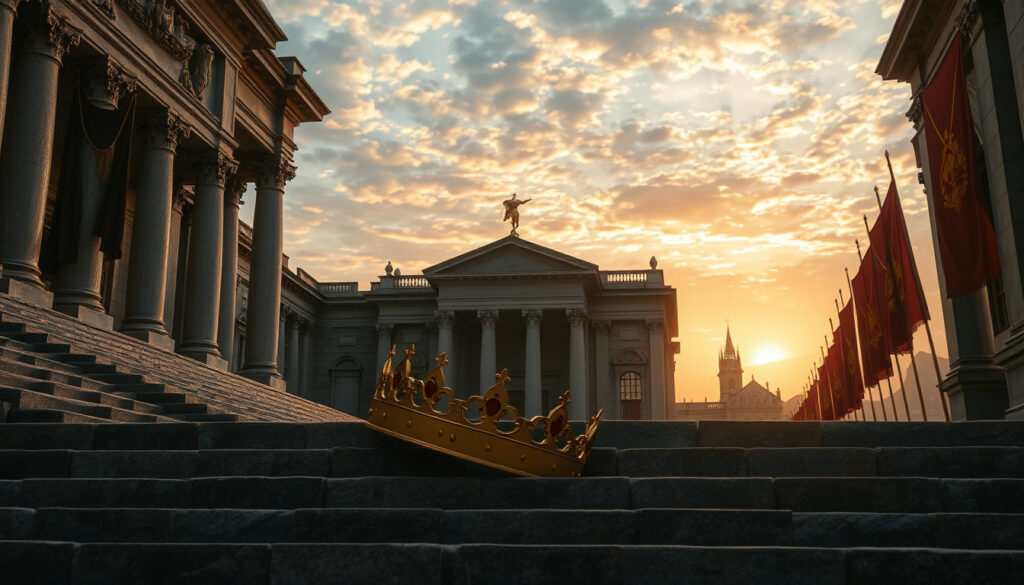
Viva La Vida Lyrics – Coldplay Full Text and Meaning
Coldplay’s “Viva la Vida” stands as one of the defining singles of the late 2000s, released in June 2008 as the fourth track from their fourth studio album, Viva la Vida or Death and All His Friends. The song quickly ascended to number one on charts worldwide, earning critical acclaim that culminated in Grammy Awards for both Record of the Year and Song of the Year at the 51st Annual Grammy Awards. Its distinctive sound, built around triumphant strings arranged in Ab Major, creates an ironic backdrop for lyrics that explore themes of power, downfall, and the fleeting nature of worldly success.
The track arrived at a pivotal moment for the British band, marking a shift in their musical direction after the introspective approach of their previous album, X&Y. Produced alongside Brian Eno, the song showcases a more ornate arrangement compared to earlier Coldplay releases, incorporating orchestral elements that lend it a cinematic quality. The composition drew heavily from historical and religious imagery, weaving together references that span centuries and cultures into a cohesive narrative about the rise and fall of a ruler facing the consequences of his choices.
Frontman Chris Martin, who studied history at University College London, drew inspiration from the story of King Louis XVI and the events surrounding the French Revolution when crafting the song’s narrative. This academic background informed the song’s perspective, allowing for a nuanced portrayal of powerlessness and regret that resonated with audiences across different demographics and cultural backgrounds. The title itself, translating from Spanish as “Long live life,” introduces an ironic counterpoint to the melancholic reflection on lost authority and faded glory.
What are the full Viva La Vida lyrics by Coldplay?
Coldplay
Viva la Vida or Death and All His Friends (2008)
“I used to rule the world”
Historical figures, particularly King Louis XVI
The song presents a first-person narrative delivered entirely from the perspective of a fallen monarch. The opening verses establish a stark contrast between past dominance and present vulnerability, with the protagonist describing how he once commanded nations but now finds himself alone and diminished. Each verse builds upon this foundation of regret while exploring different facets of his fallen state.
The complete lyrics as documented across official and authoritative sources read as follows:
I used to rule the world
Seas would rise when I gave the word
Now in the morning, I sleep alone
Sweep the streets I used to own
I used to roll the dice
Feel the fear in my enemy’s eyes
Listened as the crowd would sing:
“Now the old king is dead! Long live the king!”
One minute I held the key
Next the walls were closed on me
And I discovered that my castles stand
Upon pillars of salt and pillars of sand
I hear Jerusalem bells a-ringing
Roman cavalry choirs are singing
Be my mirror, my sword and shield
My missionaries in a foreign field
For some reason I can’t explain
I know Saint Peter won’t call my name
Never an honest word
But that was when I ruled the world
(Oh-oh-oh, oh-oh, oh)
It was a wicked and wild wind
Blew down the doors to let me in
Shattered windows and the sound of drums
People couldn’t believe what I’d become
Revolutionaries wait
For my head on a silver plate
Just a puppet on a lonely string
Oh, who would ever want to be king?
I hear Jerusalem bells a-ringing
Roman cavalry choirs are singing
Be my mirror, my sword and shield
My missionaries in a foreign field
For some reason I can’t explain
I know Saint Peter won’t call my name
Never an honest word
But that was when I ruled the world
(Oh-oh-oh, oh-oh, oh)
(Oh-oh-oh, oh-oh, oh)
Key Insights from the Lyrics
- The central metaphor of ruling the world establishes the protagonist’s former status before introducing his current fall from grace.
- “Seas would rise when I gave the word” suggests an almost divine or supernatural level of authority over natural forces.
- The crowd’s chant of “Now the old king is dead! Long live the king!” captures the cyclical nature of political power and public loyalty.
- “Pillars of salt and pillars of sand” serve as a metaphor for the fragility and instability of imperial achievements.
- Religious imagery involving Jerusalem, Roman cavalry, and Saint Peter blends historical periods to create an epic scope.
- The final question “Oh, who would ever want to be king?” presents a rhetorical conclusion that questions the value of power itself.
- Repetition of the chorus reinforces the cyclical nature of the narrative and the protagonist’s inescapable memory of his former life.
| Fact | Detail |
|---|---|
| Release Date | June 2008 |
| Album | Viva la Vida or Death and All His Friends |
| Label | Capitol Records, Parlophone |
| Track Position | Fourth track on album |
| Duration | Approximately 4 minutes 1 second |
| Musical Key | Ab Major |
| Producer | Brian Eno, Coldplay |
| Chart Performance | Number one in multiple countries worldwide |
| Awards | Grammy Award for Record of the Year, Song of the Year (2009) |
What is the meaning of Viva La Vida lyrics?
The lyrics of “Viva la Vida” function as an extended meditation on the transience of power and the inevitable consequences of authoritarian rule. The song presents a confessional narrative in which the speaker, having experienced the pinnacle of worldly authority, now confronts the emptiness that follows its loss. This perspective allows the lyrics to explore deeper questions about the nature of ambition, the authenticity of loyalty, and the possibility of redemption after moral failure.
The musical arrangement plays a crucial role in establishing the song’s ironic tone. The triumphant strings in Ab Major create a sound reminiscent of a victory parade or royal procession, yet this musical grandeur accompanies lyrics detailing failure and regret. This juxtaposition between the triumphant arrangement and the melancholic narrative produces a powerful ironic effect that underscores the disconnect between external displays of power and internal emotional states.
The Metaphor of Unstable Foundations
The phrase “my castles stand upon pillars of salt and pillars of sand” represents one of the most symbolically rich images in the lyrics. Salt, when exposed to moisture, dissolves readily, while sand shifts and shifts under any weight placed upon it. By describing his former achievements as resting on such foundations, the speaker acknowledges that his power was never truly stable despite its apparent strength. This metaphor draws on biblical imagery and traditional architectural symbolism to communicate the vulnerability of all human constructions, whether physical or political.
Religious and Historical Allusions
The references to “Jerusalem bells” and “Roman cavalry choirs” blend religious and military imagery from different historical periods, creating a sense of timelessness that elevates the narrative beyond any specific era. Jerusalem represents the spiritual center of multiple faiths, while the Roman cavalry evokes the imperial power that once dominated the Mediterranean world. Together, these images suggest a ruler whose downfall mirrors patterns repeated throughout history, reinforcing the universality of the song’s themes.
The fear that “Saint Peter won’t call my name” introduces the concept of divine judgment, suggesting that the speaker’s guilt extends beyond political failure to encompass moral and spiritual concerns. This reference to the biblical gatekeeper of heaven implies that the protagonist’s actions during his reign may have damned him, adding a layer of existential dread to his already difficult circumstances. This element connects the song to the album’s broader exploration of “Death and All His Friends,” the darker companion to “Viva la Vida.”
Lead vocalist Chris Martin studied history at university, and biographical accounts confirm that King Louis XVI served as the primary historical inspiration for the song’s narrative. The French monarch’s execution by guillotine in 1793 during the revolution provides the template for the speaker’s downfall, while the album cover depicting Eugène Delacroix’s famous painting Liberty Leading the People further reinforces this connection.
Alternative Interpretations
While the historical reading centered on King Louis XVI remains the most widely accepted interpretation, some analysts have proposed alternative readings. Biblical interpretations suggest the lyrics could represent a commentary on the nature of spiritual versus worldly authority, with some scholars noting parallels between the “puppet on a lonely string” and accounts of religious figures navigating political pressures. These readings do not contradict the historical interpretation but instead suggest multiple layers of meaning operating simultaneously within the text.
Viva La Vida lyrics in English?
The title “Viva la Vida” translates directly from Spanish as “Long live life” or “Live the life.” This phrase functions as an ironic counterpoint to the song’s content, which details the loss of life as the protagonist understood it following his fall from power. The juxtaposition between the celebratory title and the melancholic lyrics creates a tension that has generated considerable analytical discussion since the song’s release.
The complete lyrics are presented in English throughout the song, with the Spanish phrase appearing only as the title and during the melodic “oh-oh-oh” sections where the melody suggests the repetition of the title phrase. No full Spanish translation of the lyrics themselves appears in any verified version, as the song was written and performed entirely in English.
For Spanish-speaking audiences, the title itself carries cultural resonance beyond its literal translation. The phrase “Viva [something]” represents a traditional exclamation used in Spanish-speaking cultures to express approval, celebration, or acknowledgment of something’s enduring value. Using this cultural form as a title while writing the lyrics in English creates an interesting linguistic tension that reflects the global nature of Coldplay’s audience and the band’s willingness to incorporate diverse cultural elements into their work.
Meaning of the Title in Context
When considered alongside the album’s full title, Viva la Vida or Death and All His Friends, the meaning becomes more complex. The contrast between “Viva la Vida” (life, light, celebration) and “Death and All His Friends” (darkness, mortality, vengeance) establishes a thematic duality that the lyrics explore. The protagonist’s journey from power through downfall to a kind of acceptance or peace mirrors this broader album structure, suggesting that the “long live life” of the title may represent an aspiration toward reconciliation rather than an assertion of current happiness.
What are other versions like Viva la vida lyrics Marc Anthony?
Research into available sources indicates that no verified cover version of Coldplay’s “Viva la Vida” performed by Marc Anthony appears in the documented record. Searches specifically targeting this query returned no results confirming such a collaboration or cover version. It appears that any claims about a Marc Anthony version of this particular Coldplay song lack substantiation in publicly available sources.
The confusion may arise from the fact that Marc Anthony, the renowned Puerto Rican-American singer, has recorded numerous songs with Spanish titles and themes related to life and passion. However, any similarity between his work and Coldplay’s “Viva la Vida” appears to be coincidental rather than a direct cover or adaptation.
Niche Interpretations and Adaptations
The song has inspired various adaptations across different media and fan communities, though specific documentation of these versions varies in availability. Piano arrangements of the song have become common among musicians learning to play the track, with the distinctive string arrangement often translated to keyboard for solo performance contexts. These arrangements typically preserve the original lyrics, though some instrumental versions focus solely on the musical composition.
Gaming communities have also engaged with the song, incorporating it into various contexts within video game environments. While the specific nature of these adaptations falls outside the scope of documented official releases, they demonstrate the song’s continued cultural relevance and its appeal to younger audiences who may encounter it through non-traditional channels.
Timeline and Development
The creation and release of “Viva la Vida” followed a period of significant evolution for Coldplay as both artists and collaborators. The band’s work with Brian Eno, renowned for his production work with artists ranging from Roxy Music to U2, marked a departure from their earlier, more guitar-based sound toward a more expansive and atmospheric approach.
- 2005-2007: Coldplay releases X&Y (2005) and begins conceptualizing their fourth album with a more orchestral direction.
- Early 2007: Brian Eno begins collaboration with Coldplay on material that would become Viva la Vida or Death and All His Friends.
- Mid-2007: “Viva la Vida” is recorded and mixed at various studios including The Brewery in Los Angeles and The Village Recorder.
- June 2008: Single released in advance of the album, quickly climbing charts worldwide.
- June 2008: Full album Viva la Vida or Death and All His Friends released to commercial and critical success.
- 2009: Song wins Grammy Awards for Record of the Year and Song of the Year at the 51st Annual Grammy Awards ceremony.
What is established and what remains unclear?
| Established Information | Areas of Uncertainty |
|---|---|
| Release date: June 2008 | Specific studio recording dates for individual tracks |
| Grammy Awards for Record and Song of the Year | Exact contribution percentages from various producers |
| Primary inspiration from King Louis XVI | Full extent of Chris Martin’s historical research process |
| Original lyrics as documented in this article | Whether alternate versions or verses exist in unreleased form |
| Album cover inspired by Eugène Delacroix’s painting | Whether any official cover versions exist beyond the original |
| Musical key of Ab Major | Complete details of string arrangement process |
| Title translates to “Long live life” in Spanish | Whether the title phrase appears anywhere in the full lyrics |
Context and Cultural Significance
“Viva la Vida” arrived at a moment when Coldplay had established itself as one of the world’s leading commercial acts, yet faced increasing critical scrutiny regarding their artistic evolution. The song represented a successful effort to expand their sonic palette while maintaining the emotional accessibility that had driven their earlier success. The combination of literary references, historical awareness, and universal emotional themes created a work that appealed across demographic boundaries.
The album’s visual presentation reinforced its thematic concerns, with the cover art directly referencing Eugène Delacroix’s Liberty Leading the People, the iconic 1830 painting that commemorates the July Revolution in France. This visual connection to revolutionary imagery complemented the lyrical content’s exploration of power’s fragility and the people’s capacity to withdraw their support from established authorities.
The decision to frame the song’s narrative through the perspective of a fallen ruler rather than the revolutionaries themselves adds complexity to the album’s political implications. By allowing the deposed king to speak his regret and acknowledge the error of his ways, the song avoids simple partisan positioning and instead presents a humanizing portrait of historical figures typically reduced to symbolic roles.
“The song contrasts triumphant, marching strings in Ab Major with lyrics of downfall, creating irony—a victory parade sound for a confession of failure.”
“Chris Martin, a history major, drew from King Louis XVI’s execution, with the album cover as Eugène Delacroix’s Liberty Leading the People.”
Summary
Coldplay’s “Viva la Vida” represents a convergence of literary ambition, musical craftsmanship, and cultural relevance that elevated it beyond typical pop single territory. The song’s exploration of power’s transience, drawn from historical sources including the French Revolution and King Louis XVI’s downfall, resonated with audiences worldwide while earning critical recognition through Grammy Awards. Its lyrics, presenting a first-person narrative from a fallen monarch reflecting on lost authority, employ rich imagery involving unstable foundations, religious judgment, and the cyclical nature of political loyalty. The triumphant musical arrangement in Ab Major creates an ironic counterpoint to the melancholic narrative, resulting in a work that rewards repeated listening and analysis. For those interested in exploring cultural milestones of the 2008 era, this song remains a significant reference point.
Frequently Asked Questions
What album is “Viva la Vida” from?
The song appears on Coldplay’s fourth studio album, Viva la Vida or Death and All His Friends, released in June 2008. It was the fourth track on the album.
Who wrote “Viva la Vida”?
All four members of Coldplay contributed to writing the song. Lead vocalist Chris Martin served as the primary lyricist and drew from his background in history for the narrative perspective.
What does “Viva la Vida” mean in English?
The Spanish title translates directly to “Long live life” or “Live the life.” This phrase serves as an ironic counterpoint to the song’s melancholic content about lost power and regret.
What historical figure inspired the song’s lyrics?
Research indicates that King Louis XVI of France served as the primary historical inspiration. Chris Martin’s academic background in history informed his portrayal of a ruler facing the consequences of his decisions, mirroring the French monarch’s execution during the revolution.
Did “Viva la Vida” win any awards?
The song earned Grammy Awards for both Record of the Year and Song of the Year at the 51st Annual Grammy Awards held in 2009.
What is the musical key of “Viva la Vida”?
The song is composed in Ab Major, with the distinctive string arrangement contributing to its triumphant sound that contrasts with the melancholic lyrics.
Who produced “Viva la Vida”?
Brian Eno collaborated with Coldplay on the production, bringing his experience working with artists such as U2 and Roxy Music to help create the song’s orchestral textures.
Are there piano versions of the song?
Piano arrangements of “Viva la Vida” have been created by musicians learning to play the track. These arrangements typically translate the original string arrangement to keyboard while preserving the original lyrics.
What is the significance of the album cover?
The album cover features a detail from Eugène Delacroix’s painting Liberty Leading the People, directly connecting to the song’s themes of revolution, power, and the fall of monarchs.
Is there a version by Marc Anthony?
Available sources do not document a verified version of Coldplay’s “Viva la Vida” performed by Marc Anthony. Any claims about such a collaboration lack substantiation in publicly accessible records.
More related posts
 Narcissistic Traits – Signs, Gender Differences and Tests
 Michelle De Swarte – Biography, Career, Spent and Personal Life
 Home Bargain Near Me – UK Stores, Locator & Opening Hours
 Hunger Games: Sunrise on the Reaping – Key Facts Timeline
 Cast of Wedding Crashers – Full Cast List and Cameo Guide
 George Osborne – Biography, Net Worth and Current Role at OpenAI
 Prince Harry Net Worth – $60 Million and Growing in 2026
 15 Stone in Pounds – Complete Conversion Guide and Charts
